
Disclosure: This post contains affiliate links. If you book a cruise through my links, I may earn a small commission — at no extra cost to you. I only recommend products I believe in, and the opinions here are entirely my own.
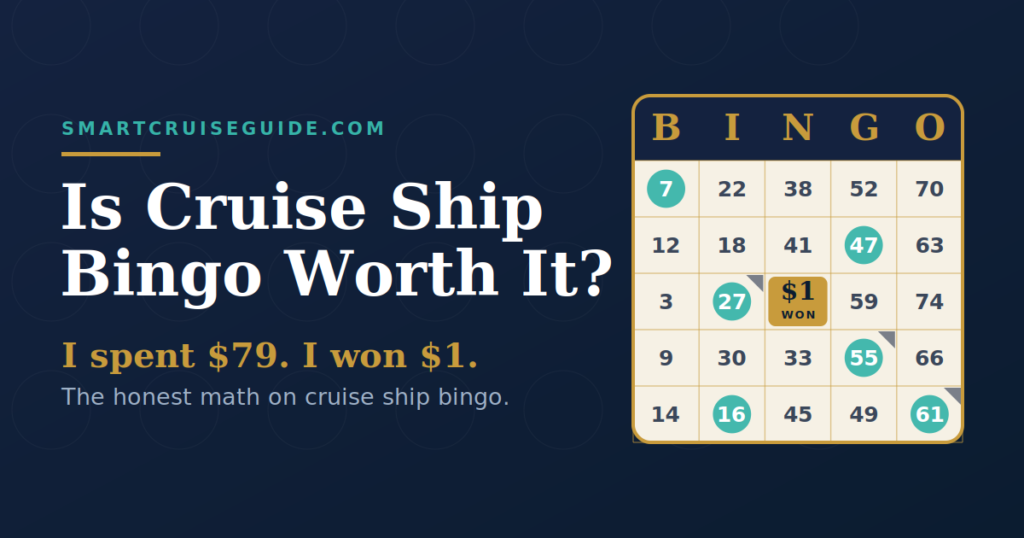
Let me save you the suspense: I spent $79 playing bingo on my last Norwegian sailing, and I walked out with one dollar in winnings and a t-shirt. That’s not a typo. Seventy-nine dollars in, one dollar out — I hit a buck across three pull tabs — plus NCL’s updated bingo tee they throw in with the top package. Woohoo.
Short on time? Watch the 60-second version of my $79 cruise bingo experiment:
So no jackpot, no coverall, no life-changing payout. Just a stack of punched-out cards, a souvenir shirt, and a onboard account that was $78 lighter than when I sat down.
So is cruise ship bingo a scam? No. But is it a smart use of your vacation money? That’s a different question — and after 18-plus cruises and more bingo sessions than I’d like to admit, I’ve got an honest answer for you.
How cruise ship bingo actually works
Bingo is one of those sea-day staples you’ll find on nearly every mainstream line — Norwegian, Royal Caribbean, Carnival, Princess, the whole lineup. On my NCL sailing, the early sessions ran in the Spinnaker Lounge — the forward observation lounge — on days at sea, when there’s nothing in port to pull people away. Then for the final, biggest session, they moved the whole thing to the Stardust Theater, the main show venue, because that’s the one with the marquee prize. More on that in a second.
Here’s the part the daily planner doesn’t spell out: you don’t pay per card, you pay per package — and the top tier is a single buy-in that covers the whole cruise’s bingo program, not just one session. You get a bundle of cards good across all the games for the week — typically a run of regular games building toward a final “coverall” (also called a blackout), where you have to fill the entire card to win the big prize.
Packages are tiered. A basic package gets you one set of cards per game; the pricier tiers stack two or three cards per game, which means more chances to win but a much faster way to burn through cash. And forget the ink dabbers you might be picturing — on NCL, each number on the card is a little perforated tab. As the caller reads a number, you punch it out and fold it back, so you’re working the card by hand the whole game. It’s oddly satisfying, but it also means juggling two or three cards at once gets genuinely frantic when the numbers come fast.
What it costs — and why my $79 isn’t unusual
This is where people get sticker shock. Cruise bingo is meaningfully more expensive than the church-hall version you might remember, and the packages have crept up over the years.
NCL’s bingo packages have historically landed somewhere in the $30 to $80 range depending on which tier you buy, the specific ship, and the sailing. My $79 was the top-tier package for the whole cruise — the one that hands you the most cards and, in theory, the best odds. One thing worth knowing: on my sailing, the top tier also came with NCL’s updated bingo t-shirt, so at least some of that $79 buys you a tangible souvenir rather than evaporating entirely. Prices shift around, so don’t hold me to an exact number for your sailing, but if you’re budgeting, assume you’ll spend at least $30 to get in the game, and closer to $80 for the loaded top tier.
Pull tabs are the other line item to watch. These are little peel-open tickets sold alongside the main game — cheap, instant, and easy to grab on impulse while you wait. I bought a few and “won” a grand total of one dollar across three of them. They’re fun, but they’re the slot machines of the bingo room: small bets, small returns, and they add up faster than you think.
Here’s exactly what my $79 top-tier package included:
- Nine cards per game
- 15 total games spread across the cruise’s bingo sessions
- 3 pull tabs
- 10 raffle tickets for the win-a-cruise drawing
- 1 NCL bingo t-shirt
Seen that way, $79 for a week’s worth of bingo plus a shot at a free cruise and a shirt isn’t as outrageous as “$79 to lose at bingo” sounds in isolation — as long as you go in understanding what you’re really buying.
That said, $79 is still real money on a cruise where nearly everything fun has a price tag attached. Even as a one-time, whole-cruise buy-in, it’s competing directly with a specialty dinner or a shore excursion — so the question isn’t “is it per session,” it’s “is this the best $79 I’ll spend onboard.”
The odds reality nobody puts in the brochure
Here’s the honest framing that matters most: cruise bingo is casino-style entertainment, not an investment. The ship sells a large number of packages, pays out a fraction of that pool as prizes, and keeps the rest. That spread is the whole business model.
The prizes can genuinely be big — I’ve seen final coverall jackpots climb into the hundreds, sometimes more on packed sea days, and some sailings run progressive jackpots that snowball if nobody hits the coverall in a set number of numbers. That’s the carrot. On my sailing, the final session in the Stardust Theater went a step further and tied in a “win a free cruise” raffle — which is exactly why they pack everyone into the big theater for it and why that last session draws the biggest crowd. A free cruise on the line is a real draw. But the math is the math: the more people in the room, the bigger the prize and the longer the odds that the winner is you.
When I dropped my $79, the room had a few hundred people in it. My realistic shot at the big coverall was somewhere south of “buy a lottery ticket.” I knew that going in. That’s the part you have to be honest with yourself about before you hand over your cruise card.
Cruise bingo vs. your hometown bingo hall
Here’s the comparison that really put my $79 in perspective. Cruise bingo is essentially one hour of entertainment. The session starts, it runs its games, and it’s over.
Back home, my local bingo hall runs about three hours for $20 to $30. So do the math: at sea I paid roughly $79 an hour to play, while my hometown hall costs me somewhere around $8 to $10 an hour. That’s close to ten times the hourly cost — and for that premium, the cruise version actually gives you less.
At the local hall I get a big table to actually spread my cards out on, payouts that dwarf anything I’ve seen at sea, and — I’d bet good money — meaningfully better odds of walking out with something. The prize pools at a dedicated bingo hall just aren’t in the same universe as a cruise session’s.
And honestly? The hometown hall wins on atmosphere too. There’s a whole culture to it: the regulars with their custom-made dabber bags, the lucky trinkets lined up along the table, the dead-serious silence when the caller gets rolling. These folks are committed. Cruise bingo is a breezy, hyped-up diversion with a microphone and an ocean view. Hometown bingo is a sport.
What the ship has that my local hall doesn’t: the t-shirt, the sea air, and the novelty of dabbing — sorry, punching — your way through a game while the coastline drifts by. Whether that novelty is worth paying ten times the hourly rate for a fraction of the time and the odds is the honest question. For most people, the answer is “worth it once, for the experience.”
So when is it actually worth it?
I’m not going to tell you to never play. Bingo can absolutely be worth it — but only if you’re buying the right thing. Here’s how I’d break it down:
It’s worth it if you’re paying for the experience, not the payout. Bingo on a sea day is genuinely fun. There’s a hyped-up caller, a buzzing room, the collective groan when someone four tables over yells “Bingo!” before you. If you’d happily pay $30 for an afternoon of that energy the way you’d pay for a movie, go for it. Treat the prize as a bonus you’ll almost certainly not get.
It’s worth it if you set a hard cap and stick to it. Decide your number before you walk in — say, the cheapest package and nothing more. The danger isn’t one $30 package; it’s the pull tabs and the “well, I already bought in, might as well grab more cards” creep that quietly doubles your spend.
It’s NOT worth it if you’re playing to win money. You will, on average, lose. That’s not pessimism, that’s how the game is designed. If your mental math is “I could win the jackpot,” reframe it before you spend, because that framing is exactly what cost me $79.
It’s NOT worth it if that $79 has a better job to do. On my sailing, that same money could’ve been a specialty dinner, a decent shore excursion, or a chunk of a drink package. Bingo competes with everything else fun onboard — and most of those alternatives give you something to keep.
My honest verdict
Cruise ship bingo is fun, it’s social, and it’s a real cruise tradition worth experiencing at least once. But it’s entertainment with a price tag, not a way to pad your vacation budget. Buy the cheap package, go in expecting to lose it, enjoy the show, and if you happen to win — fantastic, drinks are on you.
What you should not do is what I did: buy the $79 tier chasing a jackpot, then feel that little pang when the coverall goes to a stranger in row three.
Play it like a movie ticket, not a slot machine, and you’ll never feel like I did walking out of that theater.
Ready to book your next NCL sailing? Browse Norwegian Cruise Line itineraries here.
Trying to figure out where your onboard dollars actually go furthest? Bingo is just one of the “is this worth it?” calls you’ll make on a cruise — the drink package is usually the bigger one. Check out my cruise drink package break-even calculator to run that math before you sail.