
Disclosure: This post contains affiliate links. If you book a Virgin Voyages cruise through my links, I may earn a small commission — at no extra cost to you. I only recommend products I believe in, and the opinions here are entirely my own.
I’ve sailed Virgin Voyages multiple times and have always been impressed with how the line handles the experience differently from everyone else. But nothing prepared me for just how well they handled sailing with my mom — who is paralyzed and travels in a wheelchair — on the Valiant Lady. This is a review I’ve wanted to write for a while, because accessible cruising content online tends to be generic at best and misleading at worst. What follows is what we actually experienced, including where Virgin exceeded every expectation and where another major cruise line left us stranded — literally — at a port in Rhode Island.
Why We Chose Virgin Voyages for an Accessible Sailing
Choosing a cruise line when one person in your party uses a wheelchair full-time is not a simple decision. You’re not just picking a ship — you’re betting that every element of the experience, from the cabin to the gangway to the shore excursion, has been genuinely thought through rather than just technically compliant. Virgin Voyages has always marketed itself as doing things differently, and I wanted to see if that extended to accessibility. It does. Significantly.
The Cabin: Roll Right In, Roll Right Out
The accessible cabin on the Valiant Lady was the first sign that someone had actually thought about what a wheelchair user needs rather than just meeting minimum requirements. The setup was genuinely exceptional — enough turning radius, the right grab bar placement, and a bathroom that worked the way it was supposed to.
The detail that stood out most was the balcony. My mom was able to roll directly from the cabin onto the balcony without any transition, lip, or assistance required. If you’ve traveled with someone in a wheelchair, you know how rare that is. Most ships have a small raised threshold at the balcony door that requires either a ramp insert or a lift to cross. Not here. She could come and go from the balcony independently, which meant something.
Dining: Always a Place at the Table
One of the quieter indignities of dining in a wheelchair on a cruise ship is the scramble for a table that actually works — enough space to pull alongside, no awkward booth situation, no server having to rearrange half the restaurant. On the Valiant Lady, there was always a place for my mom to sit comfortably across every restaurant we tried. No advance calls, no special requests, no negotiating with a host stand. It just worked.
The Spa: The Detail Nobody Told Us About
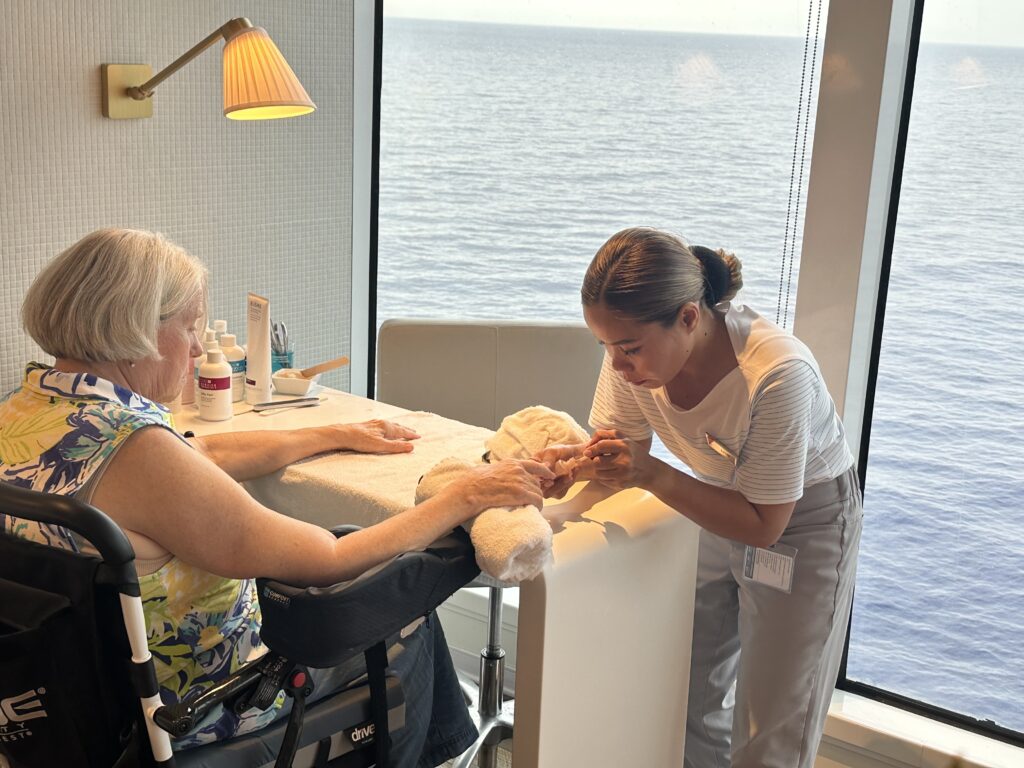
This one genuinely surprised me. My mom wanted to get her nails done — a small thing, but something that matters. I wasn’t sure how it would go logistically. The spa team at Virgin Voyages set up a portable foot bath so she could have her nails done comfortably in her wheelchair. She was, as she put it, happy as a clam. It sounds like a small thing. It wasn’t.
Most cruise ship spas are set up for guests who can transfer to a treatment table or seat independently. When that’s not possible, the answer is often a polite “we can’t accommodate that.” Virgin found a way. That’s the difference between accessibility as a checkbox and accessibility as a value.
The Private Island: A Water Wheelchair Changes Everything
This was the moment of the trip. Virgin Voyages’ private island experience includes a shuttle — and you simply roll right on. No lift, no lengthy process, no separate procedure. You roll on, you go to the resort, you roll off.
The island itself has what I can only describe as a bamboo-like pathway laid across the sand in key areas. If you’ve ever tried to push a wheelchair across beach sand, you know it’s exhausting and often impossible. These paths made it manageable — not perfect, but genuinely functional in a way that beach accessibility almost never is.
Then there were the beach wheelchairs. Virgin had two of them — chairs with oversized, wide tires specifically designed to navigate sand and go into the water. My mom got into the water. At a beach. On a cruise. I did not expect that to happen on this trip, and it happened. The experience of watching her in the water, something that most accessible cruise experiences simply don’t make possible, is not something I’ll forget.
How This Compares: A Cautionary Tale from Princess
Because contrast matters, I want to share an experience from a recent Princess Cruises sailing that illustrates exactly why doing this research beforehand is so important.
Princess is widely considered a cruise line that skews toward an older demographic — which you might assume means better accessibility infrastructure. Our experience at a port in Rhode Island told a different story.
Before the sailing, members of our party — including myself — confirmed multiple times with Princess that my mom would be able to disembark at that port in her wheelchair. We were told yes, confirmed, no problem. We had booked a shore excursion based on that assurance. When we arrived at the port, we were told she would not be able to get off the ship at all.
There was no explanation that made sense. Princess’s own website lists fully accessible shore excursions. We had been told multiple times it was possible. And yet, at the moment it mattered, it wasn’t. We missed the excursion. There was no meaningful resolution.
I’m not sharing this to broadly condemn Princess — they do many things well. But if you’re sailing with someone who uses a wheelchair, confirm accessibility at every specific port in writing, not just verbally, and have a contingency plan. Verbal confirmation, even from multiple people, is not a guarantee.
Getting There: Air Travel Tips for Wheelchair Users
Getting to your cruise ship is its own logistical exercise, and it deserves honest coverage. We flew Southwest on the way down and Delta on the way back.
Delta has a strong reputation for accessibility, and it earned it. The experience was smooth. One piece of advice regardless of airline: when you check in at the gate, tell the gate agent about your wheelchair-using passenger and the need for additional assistance — and then tell them again. Not because the first person won’t listen, but because gate staff changes, information doesn’t always transfer down the line, and the consequence of it not being communicated is your family member boarding last instead of first.
Southwest was where we learned that lesson the hard way. We were directed to a specific waiting area and told to stay there. That information turned out to be incorrect, and other passengers boarded before my mom. We still made the flight, and the trip down was ultimately fine — but the unnecessary scramble was avoidable.
One non-negotiable for electronic wheelchair users: confirm before you travel that your wheelchair’s batteries are TSA-approved and that they are removable. Airlines are required to transport wheelchairs, but the battery requirements are strict and non-negotiable at the gate. Finding out your batteries don’t comply when you’re already at the airport is not a situation you want to be in. Confirm this when you book the flight, not the day before.
The Bigger Picture: Accessible Travel Starts With Other People
Cruise lines can do everything right — wheelchair-accessible cabins, beach wheelchairs, roll-on shuttles, spa accommodations — and it can still be undone by the people standing around you. I want to share something that happened recently, because I think it belongs in any honest conversation about traveling with someone who has a mobility disability.
I was in a crowded elevator vestibule on a cruise ship. The elevators were slow, the crowd was backed up, and among the people waiting was a passenger in a scooter. The elevator arrived, and without a second thought, every able-bodied person in that vestibule crammed in — while the passenger in the scooter sat outside, left behind. I asked her if she had been waiting before everyone else. She said yes.
I turned to the elevator — a mix of younger and older passengers, some easily senior age — and asked them directly: “Don’t y’all know what elevator etiquette is? This passenger is disabled and has been waiting. At least have the courtesy to let them on first.” The looks I got were unmistakably guilty. Nobody got off the elevator.
The passenger and her husband thanked me for trying. I walked away furious.
No cruise line policy can fix that. No accessible cabin design accounts for the moment when a crowd decides, whether consciously or not, that their convenience matters more than someone else’s dignity. If you’re sailing with someone who uses a wheelchair or scooter, build extra time into every elevator situation. Position yourself near the door before it opens. And if you ever find yourself in a crowded vestibule, be the person who holds the door and says something — because apparently, someone has to.
Accessible travel is a team effort. The cruise line is part of that team. So are the people on the ship with you.
Bottom Line: Virgin Voyages Sets the Standard
I went into this sailing hoping Virgin Voyages would be good at accessibility. I came away thinking they’re actually trying — which sounds like a low bar but, having cruised multiple lines with my mom, I can tell you it’s rarer than it should be.
The cabin access, the balcony, the dining experience, the spa nail service, the island shuttle, the bamboo sand paths, and most of all those beach wheelchairs — every one of those details represents a decision someone made to do more than the minimum. That’s what accessible travel should look like, and Virgin Voyages on the Valiant Lady delivers it.
If you’re planning a cruise with a wheelchair user in your party, Virgin Voyages belongs at the top of your list. And if you’re sailing any line to a port where accessibility matters — confirm it in writing, confirm it again, and have a backup plan anyway.
Ready to book Virgin Voyages? You can browse sailings and check availability on the Virgin Voyages site here. The accessibility team can be reached before booking to confirm specifics for your situation.
Have you sailed with a wheelchair user on Virgin Voyages or another cruise line? Share your experience in the comments — this is a community that benefits from honest firsthand accounts.